
As we all now know, Ontario is under a state of emergency and a stay home order. If you are operating a business that is still open, you need to know what you should be doing to ensure that everyone stays safe and in compliance with the law.
Firstly, everyone should be working from home, unless the nature of their work requires them to be on site.
Only businesses on this list can be physically open.
Rules For Businesses That Are Open
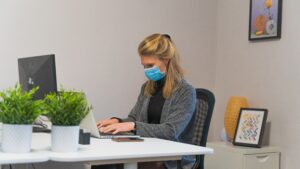
For businesses that are open, the person responsible for the business needs to ensure that if individuals are indoors or in vehicles they need to be masked. The guidance from the government is that bandanas and scarves are insufficient. Masks need to cover the mouth, nose and chin.
Personal protective equipment should also be worn, to cover the person’s eyes, nose and mouth if the person is required to:
a) come within two metres of another person who is not wearing a mask or face covering in a manner that covers that person’s mouth, nose and chin during any period when that person is in an indoor area; and
b) is not separated by plexiglass or some other impermeable barrier from a person described in clause a. (O. Reg 82/20 s.2(7))
Individuals inside the workplace also need to maintain physical distancing of 2 metres.
For the full list of rules and exceptions, check out the Regulations and the plain language government shutdown guidance doc.
COVID-19 Safety Plan
Workplaces that are open need to have a COVID-19 Safety Plan and be prepared to provide this to visiting health and safety inspectors. There is no specific required form of the plan, but it should consider all applicable public health guidance and be communicated to all workers.
Mandatory Screening
Screening continues to be mandatory for all workplaces and the previous guidance has been updated. You can find the new Screening Tool, current as of January 7, 2021, here. Employers need to ensure that they are using this tool before or at the time the worker shows up for their shift or workday. It also applies to essential visitors, such as delivery people, maintenance people or contractor workers. Essential visitors should be screened when they arrive at the workplace. Anyone who does not pass the screening should not be allowed in the workplace.
Employers need to keep the results of their screenings, as these may be requested by inspectors or by public health to assist in contact tracing.
If you need help navigating how to operate your business during the lockdown, get in touch for a consultation.