
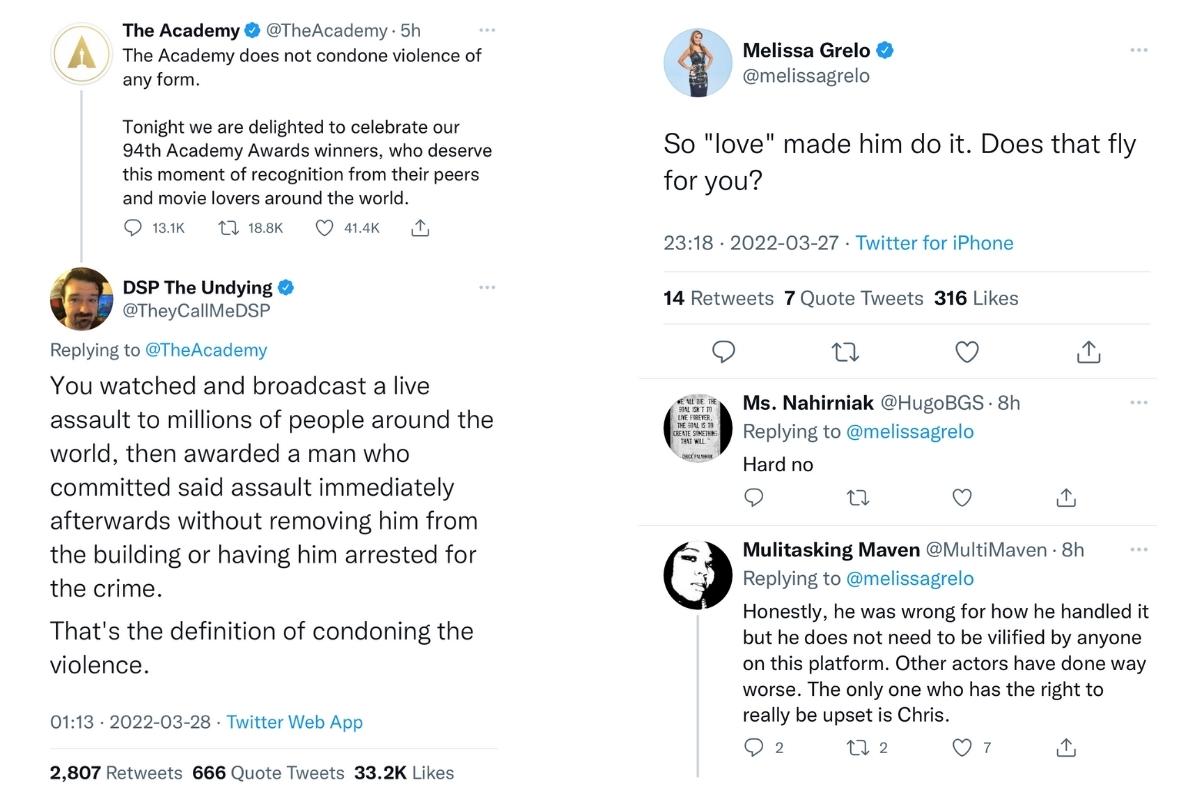
 If you missed the Oscars last night, you missed viewing a crime in real-time. The live and at-home viewing audience witnessed an assault. If you haven’t seen it, you can view the clip here. Chris Rock told a joke about Jada Pinkett, and her husband, Will Smith, then walked onto the stage, hit Chris Rock across the face, and went on to retort with profanity on live television. What’s more shocking than the act itself, is that the Oscars live broadcast continued without acknowledgement of the incident and later gave Will Smith an award.
Let’s talk about the law of assault (at least the Canadian definition). Section 265 of the Criminal Code of Canada says a person commits assault when: without the consent of another person, they apply force intentionally to that other person, directly or indirectly. Simply put, it is an assault, if one is making, or attempting to make, contact with another person without their consent. This is sometimes referred to as a common assault or simple assault because it is not aggravated (serious injuries) or with a weapon.
Potential defences against a charge of assault include:
- Provocation (which can reduce a charge),
- Consent (two people consented to a fight)
- Self-defence or defence of another
However, this incident was neither a consensual fight nor was it self-defence or defence of another. Will Smith may have felt like he was defending his wife, but assaulting someone because they made a joke would not make out the requirements to advance a defence of another person because there has to be an element of protection of a person who is in danger.
This incident illustrates serious gaps in the way crime violates our societal norms, the way the law is applied and enforced, and the way we talk about equality. Here are a few observations and questions:
- Chris Rock didn’t stop the show or demand justice. Is this how we expect victims to act? Not all victims of crime immediately call the police, demand that the person who hurt them be charged, or cry out for assistance.
- If Chris Rock had been a woman who was assaulted during a broadcast, by a man, would the show still have continued? Doubtful. The way we treat violence between genders continues to be shrouded in gender-based stereotypes. It would NOT be okay to assault a woman, but Chris Rock “took it like a man” and the show went on.
- In 2022, why did a powerful female actress, offended by a joke, need her husband to stand up for her, resorting to violence to show his devotion? Where does this fall in the quest for gender equality?
- Is this incident a product of cancel-culture? Have we become too sensitive to hear a joke without responding with an over-the-top or violent reaction? Will we resort to public displays of violence and vitriol to condemn anything we don’t like, even when said in jest?
- Or, has the practice of deeply personal attacks for the sake of comedy gone too far? It started with Ricky Gervais being praised for his acerbic takedowns of “Hollywood Elite” and has evolved over the last decade into open season on people’s most sensitive shortcomings.
- If a similar assault took place in the workplace by the boss or by an important client, are we to apply a different standard that justifies a milder reaction? Would the requirements for a workplace investigation not apply?
Will Smith slapping Chris Rock at the Oscars brings up all sorts of questions and there is a lot of gray area to explore. But, one thing is clear, this was an assault.
Further, it highlights that when people in positions of power commit crimes they may be treated differently than those most vulnerable in society. We regularly run into this with powerful, often particularly profitable managers in workplaces.
Recently, I received an arrest call from a client who threw an empty styrofoam cup at his personal support worker. The police did not hesitate to lay a charge of assault. Telling police that the client was provoked by something that happened did not convince the police not to lay a charge, nor will it be a defence in court.
Are you charged with a criminal offence or would like to continue the discussion? Is it a criminal offence allegation impacted by workplace law issues? Get in touch with me to arrange a consultation: jg********@*******aw.ca or DM me: @litgationlawyer.