
 Are you a US employer with operations in Canada? Welcome and bienvenue to this blog series written just for you. Our Canadian virtual employment law firm advises many US employers who have employees and contractors in Canada. I love this conversation. We’re neighbours who share so many similar cultural values, pop culture references and the world’s longest unsecured border. And yet there are fundamental differences in our countries’ respective workplace laws and workplace culture. It often catches our US employers by surprise and triggers very expensive moments in the employment relationship.
This series will cover these topics:
- Canada by the numbers
- Canadian employment law 101
- Why contracts are a big deal in Canadian employment law
- Terminations in an anti-at-will environment
- How to fire nicely
- The hairiest differences:
- Exempt vs non-exempt
- Overtime
- Parental leaves
- Privacy rights
- The impact of Canada’s public healthcare on employer negotiations
Canada by the Numbers
For US HR folks too polite to ask all the basic questions, here is a backgrounder on why Canada produces such a different workforce culture.
The US is 10x bigger by population and economy, yet Canada’s land mass is larger. Our countries share a historical immigration pattern, but geography has driven a very different result. This in turn has impacted our workplace cultures and worker skill sets.
All of Canada has 39.7 million people, which is similar to the state of California alone. Unlike the US, 90% of Canada’s population lives along the southern border, with 80% of our overall population concentrated in urban areas, rather than spread across the countryside. Half the country lives in 3 main city areas: Vancouver, the Edmonton/Calgary corridor & Toronto.
Despite the stereotype of trees, beavers and red plaid jackets, Canada actually has a highly digitalized, plugged in and skilled workforce given that urban density and infrastructure. We just also really like the outdoors as soon as it’s not minus a billion outside.
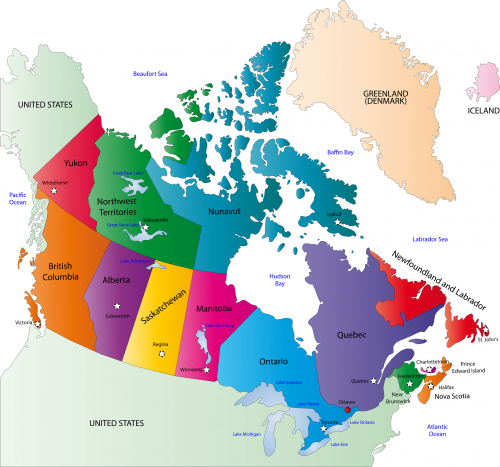
Here’s where most of Canada lives:
- 39% live in Ontario
- 23% in Quebec (21% of Canada is Francophone)
- 14% in British Columbia
- 12% in Alberta
Canada’s GDP largely reflects our population spread:
- 38% from Ontario
- 20% from Quebec
- 15% from Alberta
- 14% from BC
- The remaining 13% of our GDP is generated by the remaining provinces & territories
If you are opening up operations in Canada or are sending up a contractor scout to test the market, you’re likely going into one of these larger provinces.
Canadian Employment Laws 101
So which law applies when you do open up operations? In contrast to traditional US employment law, our employment laws generally default to the local provincial or territorial law under Canada’s constitutional division of powers. This means about 90% of employees are governed by the local provincial or territorial law, not federal law.
Federal law applies only to those workers in a federal cross-country industry, such as telecoms, railways, Canada Post and workers employed by the federal government.
Most of Canada has a common law system similar to the US, both originally based on England’s system. And then there is Quebec. Quebec is based on the civil code system in France and has deeply protected rights around the French language and Quebec culture generally. Quebec has not held a referendum to separate from Canada since the 1990s (it was close!), but there remains a unique, strong culture in Quebec. Workplaces feel different in Quebec, and US employers will want to enter Quebec with eyes wide open.
If you are looking for a great free resource of all Canadian laws online, our go-to remains CanLII (https://www.canlii.org/en/), the online database provided by the various law societies across the country.
Next in the Series
Now that you have the basic background, stay tuned for my next post on why employment contracts are a necessary, big deal in Canada.